Fault injection: testing --auto-retry without breaking a node⚓︎
--auto-retry exists for the failures you
cannot schedule: a shepherd killed on one node, a gloo peer that stops
answering, an XPU that runs out of resources mid-step. Those are hard to
arrange on purpose and harder to arrange repeatedly, which is why the
failover loop went a long time with 161 tests that all replaced the
subprocess with a fake.
This page covers the harness that removes that excuse: a trainer that checkpoints, resumes, and dies on cue, driven through the real loop. Every failure signature it emits is copied from a real captured log.
For what recovery costs at real scale, see Checkpoint restart — 2 Sunspot nodes, a 23 GB checkpoint, 10.4–11.1 s per restart. This page is about the loop's decisions; that one is about the I/O.
The two are worth keeping apart, because both survive a pkill -9 and
carry on training, so they look alike from outside:
| what fails | what recovers | |
|---|---|---|
| Checkpoint restart | the training process | relaunch on the same nodes, resuming from the last checkpoint |
--auto-retry (here) |
a node — or any retryable failure it cannot pin on one | a named host is retired; otherwise a spare is rotated in blindly. Either way the job runs elsewhere |
The difference is whether the node set changes. Note the hedge in that
second row: only a scraped, named host yields BAD_NODE_KNOWN. A
watchdog timeout or an unrecognised crash still burns a spare, on the
guess that a node is at fault — see the classification table below.
And a retry of any kind requires a spare to exist: with none, the
verdict is EXHAUSTED and the job stops. Checkpoint restart is
measured on real hardware, and so is node-swapping — including, since
job 12473751, the identification of which node died: a real node loss
emits rank N died from signal 9, the scraper names that host, and the
loop retires it rather than guessing. See
On-node validation, and
Node-kill postmortem for the three bugs
between "a node was swapped" and "the right node was swapped".
The experiment⚓︎
Four attempts against a 300-step job checkpointing every 25 steps, with
a shepherd died from signal 9 injected at steps 60, 145 and 240:
python3 experiments/fault-injection/run_faults.py \
    --total-steps 300 --ckpt-every 25 \
    --fail-at 60,145,240 --fail-on 1,2,3 \
    --out fault_run.jsonl

python3 experiments/fault-injection/plot_faults.py fault_run.jsonl \
    -o fault-injection.png
No scheduler, no MPI, no allocation — run_with_auto_retry takes an
arbitrary command, so the whole run finishes in about four seconds on a
laptop.
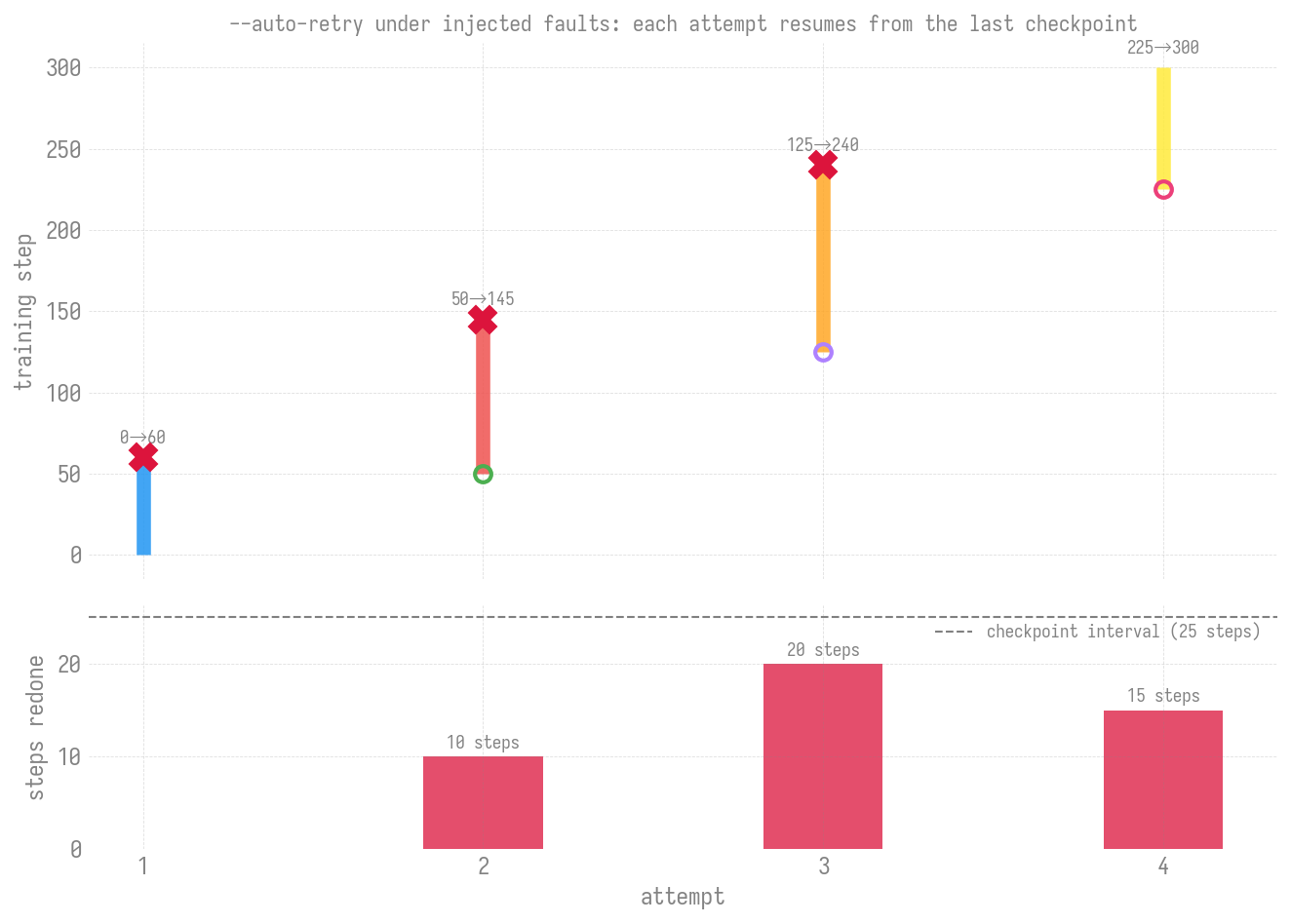
Results⚓︎
rc=0  attempts=4  elapsed=4.04s
  attempt 1: steps   0→60   resumed_from=None  fault=shepherd_sig9
  attempt 2: steps  50→145  resumed_from=50    fault=shepherd_sig9
  attempt 3: steps 125→240  resumed_from=125   fault=shepherd_sig9
  attempt 4: steps 225→300  resumed_from=225   fault=None
  bad nodes retired: [x1922c7s6b0n0.hsn…, spare-1, spare-2]
| attempt 1 | 2 | 3 | 4 | |
|---|---|---|---|---|
| resumed from | — | 50 | 125 | 225 |
| died at | 60 | 145 | 240 | — |
| steps redone | — | 10 | 20 | 15 |
| node retired | ✓ | ✓ | ✓ | — |
Three things worth reading off that:
- The job finished. Three separate hardware-style deaths,
rc=0, all 300 steps completed. That is the whole promise of the flag. - Redone work never exceeded the checkpoint interval. 10, 20 and 15
steps against a 25-step interval — you only ever repeat work since the
last save. Halving
--save-intervalhalves the worst case, at the cost of more save I/O. - A node was retired each time. A host went into
bad_nodes.txtand out of the active hostfile, and a spare took its slot, so the next attempt ran somewhere else.
Only the first retirement was evidence
Since #233,
bad_nodes.txt records why each host was retired, and re-running
this scenario shows the three retirements were not alike:
x1922c7s6b0n0.hsn.cm.sunspot.alcf.anl.gov  scraped  attempt=1
spare-1                                    blind    attempt=2
spare-2                                    blind    attempt=3
Only attempt 1 named a host. On attempts 2 and 3 the injector
reprinted the same signature — for a host that had already been
swapped out — so swap_in matched nothing, the loop fell back to
swap_one_blind, and two healthy spares were retired instead. The
reprinting is an artifact of the injector using a fixed hostname,
but the code path is the real one: when the scraper names only
already-retired hosts, blind rotation burns healthy nodes. Before
provenance was recorded, bad_nodes.txt presented all three as
equally bad.
Why the x-axis is attempts, not wall-clock
At this scale an attempt takes about a second, and
_run_attempt_with_tee notices the child exited only on its next
poll tick — a flat 1.0 s with the watchdog off. Measured wall-time
would therefore mostly describe a sleep, so it is not charted.
Step progression and redone work come exactly from the logs.
For real recovery timing, Checkpoint restart
measures 10.4–11.1 s per restart on Sunspot, where the cost is
dominated by process launch, distributed init and dcp.load — none
of which this harness simulates.
What gets injected⚓︎
tests/_faultinject.py is configured entirely by environment variables,
with a counter file so attempt N can behave differently from N+1.
Each mode emits a signature taken from
ezpz.failover.patterns
or _CRASH_PATTERNS_RX — a made-up string would only prove the harness
can match itself.
FI_MODE |
emits | classified as |
|---|---|---|
shepherd |
<host>: shepherd died from signal 9 |
BAD_NODE_KNOWN — the host is named |
gloo_peer |
RuntimeError: [..gloo..] Connection closed by peer [ip] |
BAD_NODE_BLIND¹ |
ur_oom |
UR_RESULT_ERROR_OUT_OF_RESOURCES |
BAD_NODE_BLIND |
rank_exit |
<host>: rank 7 exited with code 1, rc 143 |
retried² |
innocent_cascade |
rank N died from signal 15, rc 143 |
WALLTIME — not retried² |
clean_walltime |
normal output, rc 143 | WALLTIME |
hang |
goes silent | watchdog kill, rc 124 |
sigkill |
SIGKILLs itself |
negative rc, retried |
silent_fail |
nothing a scraper can name | BAD_NODE_BLIND |
enospc |
OSError: [Errno 28] No space left on device plus the PALS teardown cascade, rc 143 |
RETRYABLE_UNATTRIBUTED — retried, no spare burned³ |
enospc_named |
the same, with a shepherd died from signal 9 line the scraper can name |
RETRYABLE_UNATTRIBUTED — the named host is not retired³ |
FI_MODE also accepts a comma-separated list, in which case the Nth
entry drives attempt N (the last repeats). That is how the
budget-reset test alternates failure kinds within one run.
¹ Named only when the IP reverse-resolves, which needs getent — so
off-cluster it falls back to a blind rotation.
² These two are the interesting pair. Both exit 143, the code a PBS
walltime kill produces, but one is a real crash that must be retried and
the other is the SIGTERM cascade every clean walltime kill emits. The
classifier strips rank N died from signal 11|15 before matching crash
patterns, which is what keeps a walltime expiry from burning a spare on
every job.
³ The ENOSPC traceback and cascade are transcribed from Sunspot job
12473704 (see the warning below). Only the co-occurring shepherd line
in enospc_named is reconstructed: the excerpt in
#231 scrapes to nothing
on its own, yet the incident was classified BAD_NODE_KNOWN, so the
full log must have carried a signature the scraper matches. Both
signatures are real; only their pairing is inferred.
Running it yourself⚓︎
The tests are the fast path — 29 of them, about fifteen seconds, no allocation:
They assert on outcomes rather than internals: the return code, how many
attempts really ran, which host landed in bad_nodes.txt, and what the
active hostfile says next.
To explore a scenario, drive the injector directly:
export FI_COUNTER=/tmp/attempts.txt FI_CKPT=/tmp/ckpt.json
export FI_TOTAL=100 FI_CKPT_EVERY=10 FI_FAIL_AT=35 FI_MODE=ur_oom
echo 0 > $FI_COUNTER
python3 tests/_faultinject.py    # run it twice: the second resumes
Full knob list is in the module docstring.
Scope⚓︎
This harness deliberately does not simulate the expensive parts of a restart. The "model" is a single integer in a JSON file, so the numbers here are microseconds where a real job spends seconds on process launch, distributed init and reading a sharded checkpoint. What it does exercise for real is every decision the loop makes, the subprocess plumbing, the idle watchdog, the scraper, and the hostfile rewrite.
On-node validation⚓︎
The one claim no in-process test can make is that the next attempt's
mpiexec actually lands somewhere else. That needed real hardware, and
experiments/fault-injection/autoretry_nodekill.pbs now does it: 4
Sunspot nodes split 2 active + 2 spare, pbsdsh -n 0 killing the ranks
on exactly one active node mid-training, with --auto-retry driving the
retry loop.
Sunspot job 12473704, killing x1921c1s0b0n0 after checkpoint 40:
| attempt | ran on | resumed | died of | verdict |
|---|---|---|---|---|
| 1 | s0b0n0 (victim), s1b0n0 |
— | 13 ranks kill -9'd, rc -9 |
BAD_NODE_BLIND |
| 2 | s1b0n0, s4b0n0 (spare) |
step 40 | [Errno 28] mid-save, rc 143 |
BAD_NODE_BLIND |
| 3 | s1b0n0, s5b0n0 (spare) |
step 280 | [Errno 28] again, rc 143 |
EXHAUSTED |
Attempt 2 is the result: a spare was rotated in, the victim was gone from the active hostfile, and the relaunch resumed from step 40 on a different node set. Node-swapping works on real hardware.
Identification now works — reconfirmed on job 12473912
This section is history. As of Sunspot job 12473912
(2026-08-26, rerun on current main) the loop names the node that
actually died, 7/7 including the discriminating check:
PASS  the kill actually landed on x1922c7s5b0n0-hsn0...
PASS  the swap was scraper-IDENTIFIED (not a blind guess)
PASS  killed host is OUT of the active hostfile
PASS  final attempt did NOT run on the dead host
OVERALL: PASS

bad_nodes.txt: x1922c7s5b0n0-hsn0...  scraped  attempt=1
[auto-retry] bad nodes: ['x1922c7s5b0n0...'] — swapped 1
[auto-retry] FAILOVER STOP: success (attempt 2)
That is scraped, not blind, and the harness now kills
active[1] — so a blind rotation, which always evicts
active[0], cannot pass by luck. All four issues named below are
closed: #231,
#232,
#233,
#234.
The original write-up is kept below, because why it could not identify anything is the more useful lesson.
Original 12473704 finding: it worked; it did not identify anything
Note the verdict column: BAD_NODE_BLIND twice, never
BAD_NODE_KNOWN. A kill -9 leaves no scrapeable signature at all —
attempt-1.log just stops mid-training — so both swaps were
swap_one_blind evicting active[0]. pbsdsh -n 0 happens to kill
the first allocation node, which is active[0], so the guess was
right by construction of the test. Killing active[1] instead made
the old code retire a healthy node and leave the dead one in
(#234) — fixed;
that is exactly the case job 12473912 now passes.
Attempt 2 compounded it: an OSError: [Errno 28] No space left on
device during a checkpoint save retired s4b0n0, a healthy node.
Note this was also a blind eviction, not the scraper believing the
teardown cascade — the cascade lines scrape to [], verified. Since
#231 a storage error
classifies as RETRYABLE_UNATTRIBUTED, retrying in place without
retiring a node or consuming a spare (see the
termination matrix).
Attempt 2 shows the cost directly: it evicted s4b0n0, a healthy
node rotated in one attempt earlier, purely for sitting at index 0.
And the [Errno 28] that killed it was retryable — /lus/tegu
was 10% full, but two of its four OSTs were at 99–100% and the
directory striped stripe_count: 1.
The full walkthrough — the scraper run that returns empty, the
lfs df output, and what the run does and does not establish — is in
Node-kill postmortem. Tracked as
#231,
#233 and
#234.
Two harness bugs are worth recording, because both produced confident wrong verdicts before any of the above was true:
pbsdsh -- bash -c '<multi-line>'does not survive the trip (syntax error: unexpected end of file). The kill never landed, the job trained to completion, and a trailing|| truereported success anyway. The killer is now a file, and reports non-zero if it kills nothing.- Two assertions passed vacuously when there was no relaunch: an untouched hostfile still has N hosts, and attempt 1 — which ran before the kill — naturally never names the victim. They are now gated behind the relaunch check, which is evaluated first.
The general lesson: a chaos harness that cannot distinguish "the fault was injected and handled" from "the fault was never injected" reports the second as the first.