Checkpoint & Restart Under Failure⚓︎
How ezpz.examples.fsdp_tp behaves when training is interrupted: how it
saves distributed checkpoints, resumes automatically, and how much a
restart-from-checkpoint actually costs — with real measurements from
Sunspot (Intel PVC / XPU), not modeled estimates.
Key API
ezpz.examples._checkpoint— DCP save/load helpersfsdp_tpflags:--ckpt-dir,--save-interval,--train-iters,--no-resume,--async-ckpt,--ckpt-stage-dir,--meta-init- Metrics:
train/restart_seconds,train/ckpt_save_seconds,train/ckpt_stage_seconds,train/ckpt_drain_seconds
How it works⚓︎
fsdp_tp uses PyTorch Distributed Checkpoint (DCP) — each rank writes
its own shard in parallel (no gather-to-rank-0 that would OOM at scale), so
it works identically under FSDP-only, HSDP, and 2D FSDP+TP.
- Save every
--save-intervalsteps into--ckpt-dir/step-<N>/. A.completemarker is written last, so a checkpoint interrupted mid-save (e.g. by the failure you're recovering from) is skipped. - Resume is automatic on startup: the newest complete checkpoint is
loaded and training continues from its step — no flag needed (pass
--no-resumeto force a fresh run).
Because resume is automatic, it composes directly with
ezpz launch --auto-retry: a relaunch simply
resumes.
ezpz launch --auto-retry --np <N> -- \
  python3 -m ezpz.examples.fsdp_tp --model debug \
    --ckpt-dir ./ckpts --save-interval 100 --train-iters 3000
This page measures restart, not failover
The two are easy to conflate, and the command above makes it
easier: --auto-retry composes with resume, but the numbers below
were not produced with it.
| what fails | what recovers | measured where | |
|---|---|---|---|
| Checkpoint restart (this page) | the training process | a relaunch on the same nodes, resuming from the last checkpoint | here — real Sunspot runs |
--auto-retry (fault injection) |
a node — or any retryable failure it cannot attribute to one | a named bad host is retired; otherwise a spare is rotated in blindly. Either way the job relaunches elsewhere | locally, plus a real 4-node Sunspot node-kill (postmortem — the swap is proven, the attribution is not) |
Both survive a pkill -9 and keep training, which is exactly why
they look alike from outside. The difference is whether the node
set changes. The experiment below uses a plain relaunch loop on a
fixed node set, so nothing here exercises node-swapping.
One asymmetry worth knowing: the plain relaunch loop always
retries, but --auto-retry needs a spare to retry at all.
Every retryable verdict is gated on has_spares
(launch_autoretry.py:490-502); with none left the run ends as
EXHAUSTED rather than relaunching. If --np claims the whole
allocation there is no spare, so ask the scheduler for more nodes
than you train on — that is what --nhosts is for.
Asynchronous checkpointing⚓︎
By default a save is synchronous — the training loop blocks while every
rank writes its shards to the durable --ckpt-dir. At large model sizes that
stall recurs every --save-interval steps. Pass --async-ckpt to overlap the
write with training:
python3 -m ezpz.examples.fsdp_tp ... \
    --ckpt-dir /shared/ckpts --async-ckpt \
    --ckpt-stage-dir /tmp/ezpz-ckpt --save-interval 100
--async-ckpt uses dcp.async_save: the state dict is staged to CPU memory
synchronously (so it's safe to keep training the instant the call
returns; tracked as train/ckpt_stage_seconds), then written to fast
node-local --ckpt-stage-dir (default /tmp/ezpz-ckpt-<jobid>) by a
background thread, and finally fanned out to the durable --ckpt-dir on
shared FS. The fan-out copy runs on a background worker (start_fanout), and
try_finalize_if_ready — called each step — stamps the durable .complete
marker (barrier, main thread) as soon as all ranks' copies finish, so the
expensive shared-FS write overlaps training rather than blocking it.
Watch stage + drain, not just the stage
The true per-save stall is ckpt_stage_seconds + ckpt_drain_seconds, not
the cheap stage alone — the first cut of the agpt-2b
measurements missed a 5 s
blocking fan-out by reading ckpt_stage_seconds in isolation. With the
fan-out backgrounded the drain residual is small (~0.7 s), but always
compare stage + drain against the sync save. One residual tradeoff: for
the ~1 copy-duration between a save and its marker, a crash falls back one
extra interval; shrink --save-interval to bound it.
Node-local staging is not durable
--ckpt-stage-dir (e.g. /tmp) is node-local and not resumable on its
own — its shards are scattered per node and it carries no completion
marker. Only the fanned-out --ckpt-dir copy on shared FS survives a node
failure, and resume always reads from there. That's why --async-ckpt
requires --ckpt-dir; /tmp is a staging tier, not the checkpoint.
The experiment⚓︎
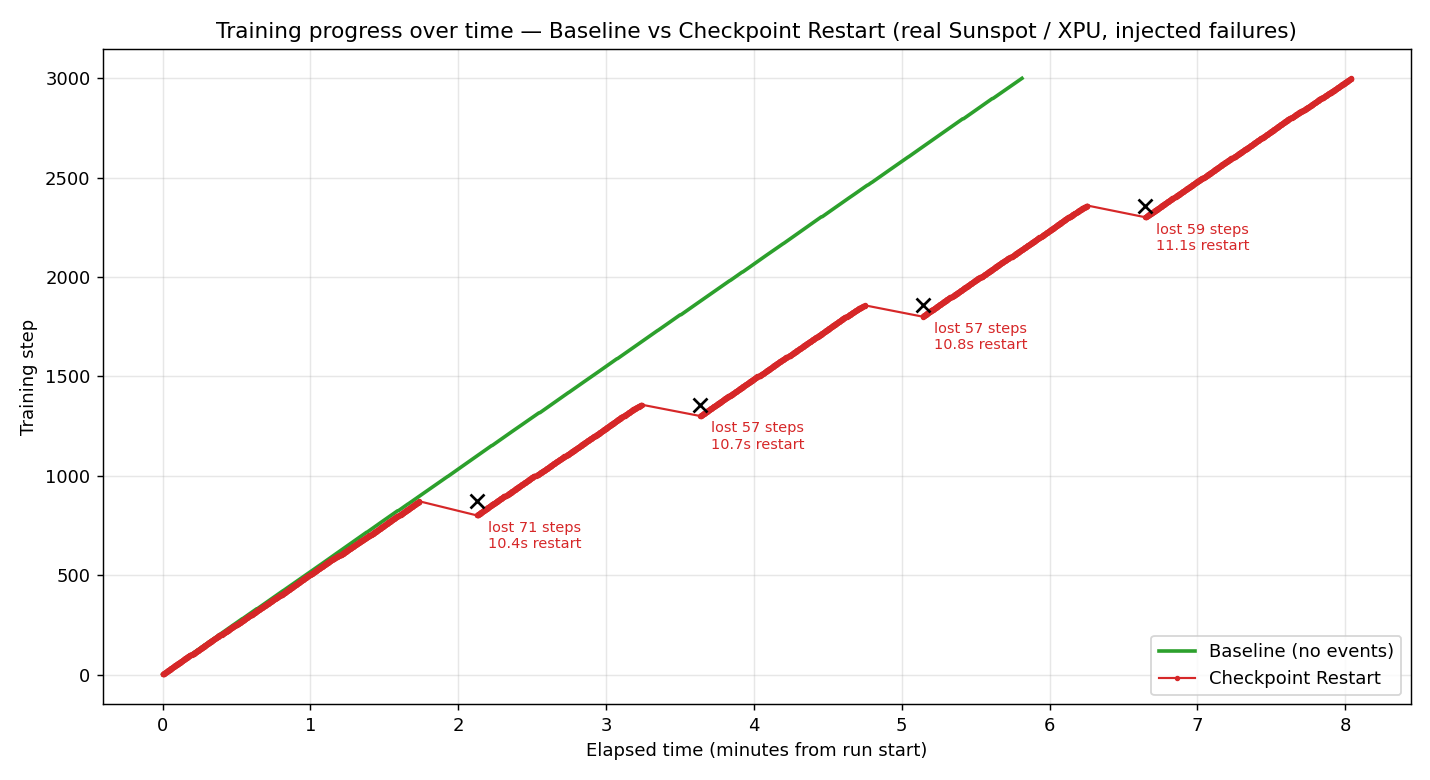
To measure restart cost we ran two 3000-step jobs on 2 Sunspot nodes (24
XPU ranks, tp=2), checkpointing every 100 steps:
- Baseline — no failures.
- Checkpoint Restart — a background loop
SIGKILLs the training ranks across all nodes every ~90 s (a realpkill -9; PALS then tears down the trainingmpiexec, each attempt exiting rc=137). A relaunch loop restarts on the same nodes andfsdp_tpauto-resumes from the last checkpoint.
The kill is pbsdsh with no node index, so it lands on every node at
once, and the relaunch is a plain while loop in the job script — not
--auto-retry. That is deliberate: with every node hit there is no
healthy/bad distinction to fail over between, and with no spare nodes in
the allocation there is nowhere to fail over to. The scripts say so in
their header comments, and it is worth repeating here because the
recovery looks identical from the outside.
Results⚓︎
| Baseline | Checkpoint Restart | |
|---|---|---|
| Steps | 3000 | 3000 |
| Wall-clock | 5.81 min | 8.04 min |
| Failures | 0 | 4 (real SIGKILL) |
| Recovery overhead | — | +2.23 min (≈38%) |
Per failure (kill → PALS teardown → relaunch → DCP resume):
| # | resume @ step | lost steps | restart_seconds |
|---|---|---|---|
| 1 | 801 | 71 | 10.40 |
| 2 | 1301 | 57 | 10.66 |
| 3 | 1801 | 57 | 10.79 |
| 4 | 2301 | 59 | 11.10 |
What the numbers mean:
- Restart cost ≈ 10.4–11.1 s, strikingly consistent.
train/restart_secondsis timed from process entry (beforesetup_torch), so it captures the full cold path: process launch + distributed init + model build +dcp.load+ first productive step. - Lost steps ≈ 57–71, bounded by the 100-step checkpoint interval — you
only ever redo work since the last checkpoint. Shrink
--save-intervalto reduce lost work (at the cost of more frequent save I/O). - ≈ 33 s total per failure (~11 s restart + ~22 s recomputing lost steps), which is the +2.23 min overhead across 4 failures.
Async checkpointing under the same failures⚓︎
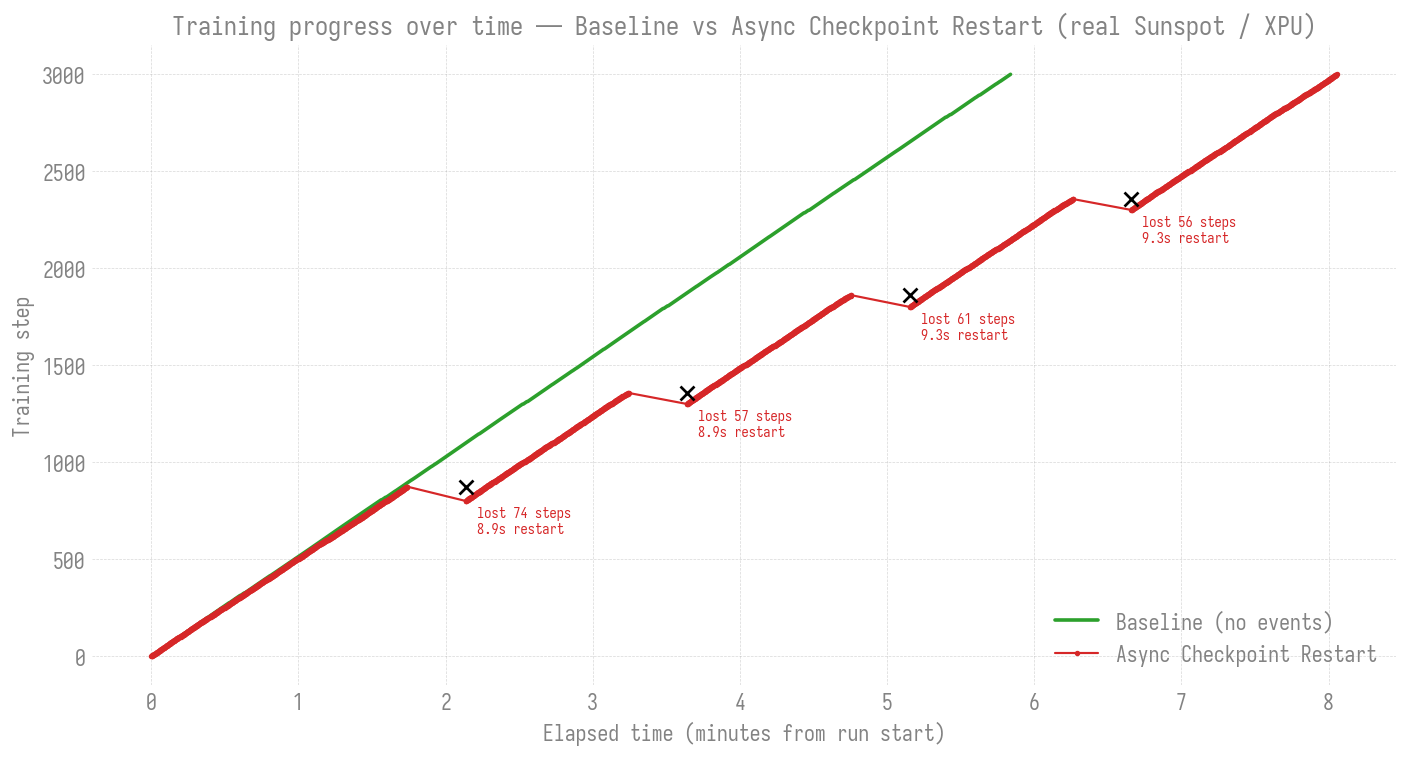
Re-running the identical experiment with --async-ckpt (stage to /tmp, fan
out to shared FS) on the same 2 nodes / 24 XPU ranks:
| # | resume @ step | lost steps | restart_seconds |
|---|---|---|---|
| 1 | 801 | 74 | 8.94 |
| 2 | 1301 | 57 | 8.94 |
| 3 | 1801 | 61 | 9.31 |
| 4 | 2301 | 56 | 9.30 |
- Per-step stage stall:
train/ckpt_stage_seconds≈ 28 ms (median) — the CPU stage barely touches the training thread. At this model's tiny checkpoint the drain (fan-out to shared FS) is also negligible, so async looks like a clean win here. But that's an artifact of scale — at 23 GB the drain becomes the dominant cost and flips the result (see the agpt-2b section). Don't generalize the debug-model stage number to real checkpoints. - Restart cost ≈ 8.9–9.3 s — the resume path is the same as sync (init +
dcp.load), so restart time is comparable (here marginally lower, within run-to-run noise). - Recovery still works identically: every kill resumed from the last durable
(fanned-out) checkpoint, never from the node-local
/tmpstaging copy.
At realistic scale: agpt-2b, a 23 GB checkpoint⚓︎
The debug-model numbers above make the mechanism clear, but the async win is
a rounding error there (28 ms stall). The whole point of async checkpointing is
large checkpoints, so we re-ran the experiment with agpt-2b (~2B params,
256K vocab) — a 23 GB sharded checkpoint — on 2 Sunspot nodes / 24 XPU
ranks, tp=2: baseline + sync restart + async restart, 2000 steps, save
every 100, 3 real SIGKILLs at steps 500/1000/1500.
Getting an honest async win took three iterations, and the two dead ends are instructive.
Dead end 1 — async was slower, and the obvious metric hid it⚓︎
The first cut looked like a landslide for async: the logged
ckpt_stage_seconds (0.30 s) was ~12× smaller than the sync
ckpt_save_seconds (3.5 s). But async's wall-clock was higher, even though
every logged metric favored it. The paradox was the tell — the cost was real
but untimed. An async save has two halves: the stage (copy state to host,
kick off the background write) is cheap, but the drain — the fan-out of the
full 23 GB from node-local /tmp to shared FS — was a blocking foreground
copy at the next step start, landing between train/dt windows, so no metric
captured it. Adding train/ckpt_drain_seconds exposed a 5.18 s blocking
drain: /tmp staging added I/O without moving the slow write off the critical
path, making async ~1.5× slower per save than plain sync. Lesson:
ckpt_stage_seconds alone is not the async cost; compare stage + drain.
Dead end 2 — backgrounding the copy, but finalizing too late⚓︎
The drain copy is pure per-rank file I/O with no collectives, so it is safe
on a background thread; only the completion barrier + .complete marker must
stay on the main thread. So start_fanout() submits the copy to a background
worker and returns immediately. But the first version stamped the marker only at
the next save boundary — one full interval later. That fixed the stall (copy
now hidden) but broke durability: a checkpoint's shards landed on shared FS
~1 copy-time after the save, yet weren't marked resumable until +100 steps.
An arbitrarily-timed crash could then fall back ~2 intervals, and the
marker-gated failure injector (it waits for .complete before killing) fired
~1 interval late, so async recomputed extra steps and still trailed on
wall-clock — a real regression masquerading as the earlier artifact.
The fix — finalize as soon as the copy is done⚓︎
try_finalize_if_ready() runs every step: a cheap MPI probe (on MPI's own
communicator, not the xccl training group — so it cannot cross-match the
gradient all-reduce and deadlock) checks whether all ranks' background
copies have finished, and stamps the durable marker the instant they have —
~1 copy-time after the save, not a full interval. Async durability now matches
sync except during the brief copy window.
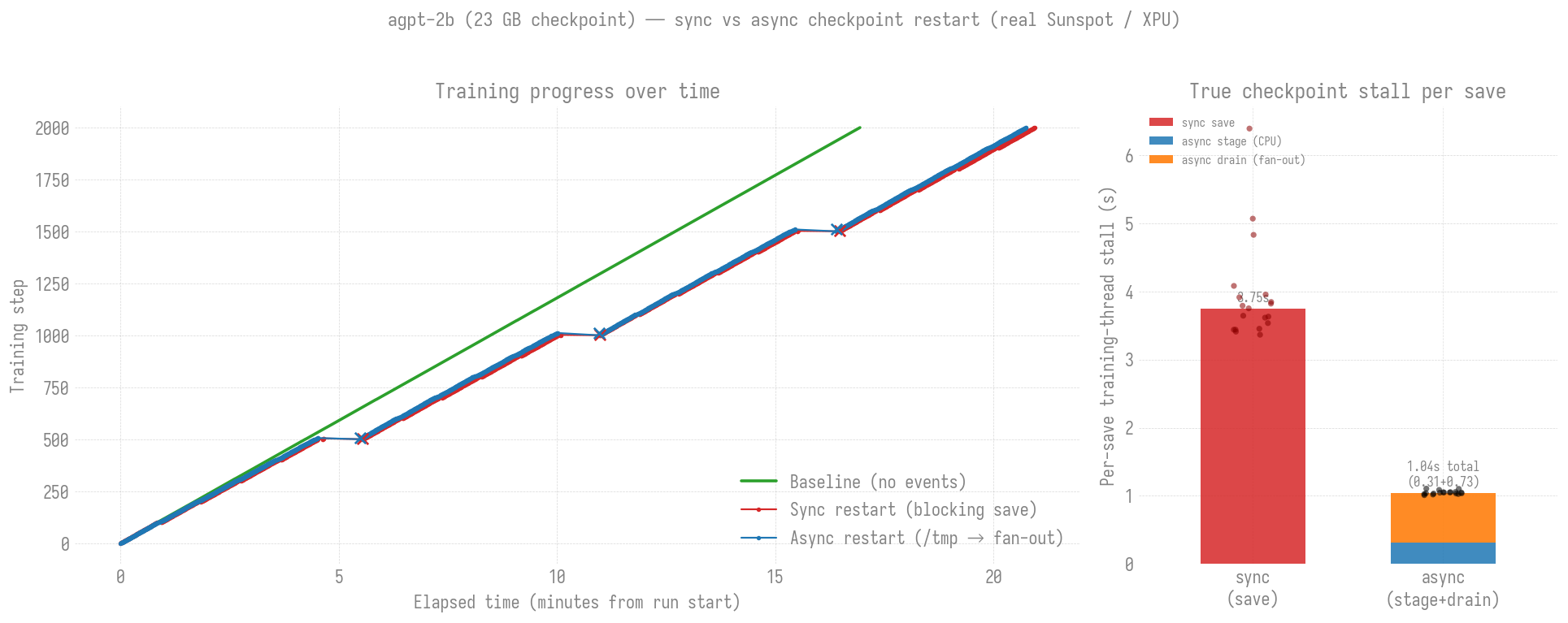
| per-save training-thread stall | sync | async (backgrounded) |
|---|---|---|
| stage | — | ckpt_stage_seconds 0.31 s |
| drain residual (barrier + marker) | — | ckpt_drain_seconds 0.73 s |
| blocking write | ckpt_save_seconds 3.75 s |
— |
| true total | ≈3.75 s | ≈1.05 s |
| Baseline | Sync restart | Async restart | |
|---|---|---|---|
| Steps | 2000 | 2000 | 2000 |
| Wall-clock | 16.94 min | 20.94 min | 20.75 min |
| Lost steps / kill | — | 2–4 | 6–11 |
- Async per-save stall is ~3.6× less than sync (1.05 s vs 3.75 s); the 23 GB copy is fully hidden and only the cross-rank barrier + marker remain. Validated on 24 ranks with no cross-thread collective deadlock — the barriers stay on the main thread in lockstep.
- Async now finishes first on wall-clock (20.75 vs 20.94 min). Over ~19 failure-free saves per phase it sheds ~2.7 s of stall each (~50 s total), which more than covers the handful of extra steps it recomputes. This is the regime async is for: many saves between rare failures.
- Lost steps are now matched (sync 2–4, async 6–11) — both resume from the identical durable checkpoints (501/1001/1501). Async's small residual is the genuine ~1-copy-window durability cost, not the earlier marker-lag artifact.
- Restart cost ≈ 40–44 s (both), dominated by the 23 GB
dcp.load+ init.
Residual durability tradeoff (bounded)
Async is still not free on durability: for the ~1 copy-duration between a
save and its marker, the newest resumable checkpoint is the previous one, so
a crash in that narrow window falls back one extra interval. This is
inherent to any overlapped write and far smaller than the earlier
full-interval lag. Recovery is never broken — the previous complete
checkpoint is always durable — and shrinking --save-interval bounds the
worst case.
Scaling up: agpt-20b, a 232 GB checkpoint (needs --meta-init)⚓︎
agpt-20b (~20B params) initially OOM'd at model build: the example moved the
full dense model onto one GPU before FSDP sharded it, capping model size at what
fits whole on a single device (~2–8B) regardless of node count. --meta-init
(default auto, on for models ≳6B) fixes this — the model is built on the
meta device, sharded, then only each rank's shard is materialized
(torchtitan's pattern). Peak memory drops from OOM (>64 GB/tile) to ~14 GB/
tile, and the same checkpoint-restart experiment then runs unchanged:
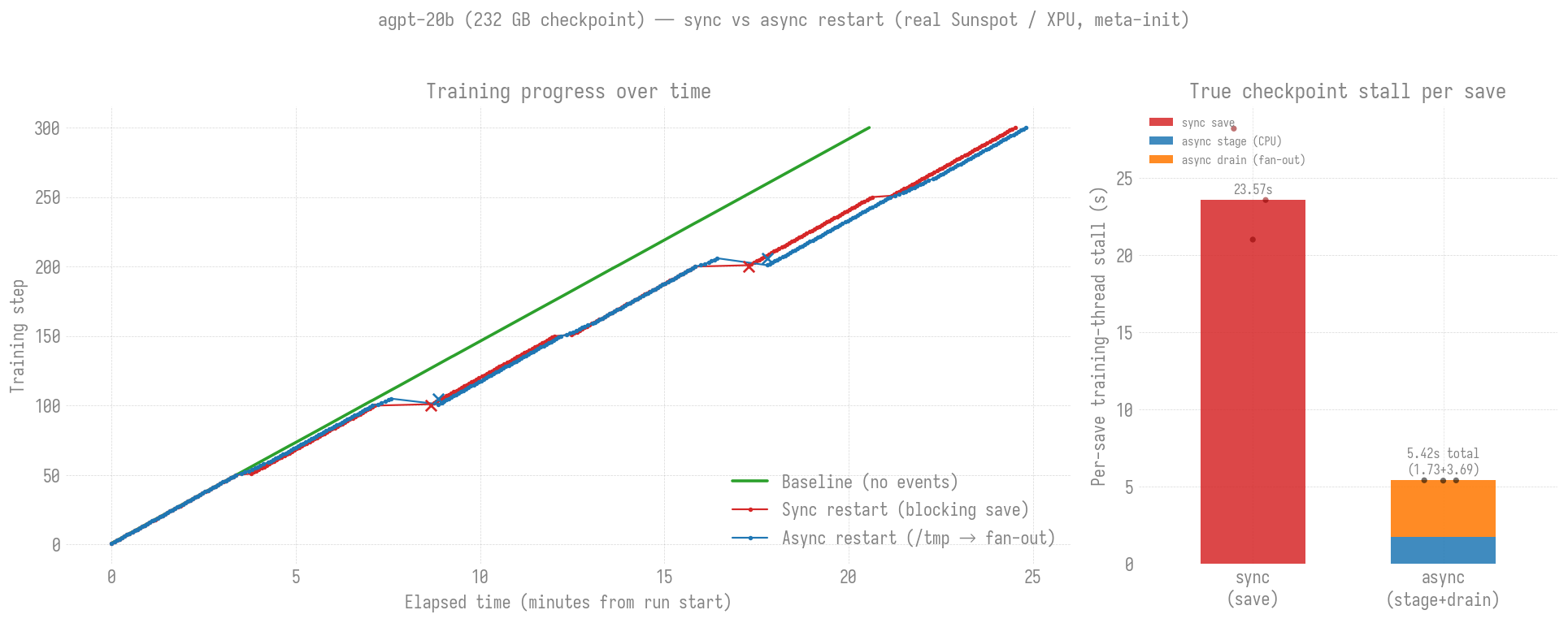
| per-save training-thread stall | sync | async (backgrounded) |
|---|---|---|
| stage | — | ckpt_stage_seconds 1.73 s |
| drain residual | — | ckpt_drain_seconds 3.69 s |
| blocking write | ckpt_save_seconds 23.57 s |
— |
| true total | ≈23.6 s | ≈5.4 s |
- The async win scales with checkpoint size. At 232 GB a synchronous save freezes the training loop for ~24 s every checkpoint; backgrounded async cuts that to ~5.4 s — 4.4× less, an ~18 s/save saving (vs ~2.7 s at 2b). The bigger the checkpoint, the more the fan-out is worth hiding.
- Restart cost ≈ 55–63 s (both), dominated by the 232 GB
dcp.load. - Meta-init composes with everything: TP + FSDP2 sharding, DCP save/resume
(verified restoring from a 232 GB checkpoint), and the backgrounded fan-out —
all at 20B on 4 Sunspot nodes with no OOM. Small models (agpt-2b and below)
stay on the exact dense-init path (
autokeeps them bit-for-bit).
Measuring it yourself⚓︎
fsdp_tp logs a RESUMED from step=N line on resume and a
train/restart_seconds metric on the first post-resume step (into the
metrics JSONL and W&B). The driver script + a reusable plotter live in the
repo under experiments/checkpoint-restart/:
qsub experiments/checkpoint-restart/restart_experiment.pbs   # 2 nodes
python3 experiments/checkpoint-restart/plot_restart.py \
    expt_<jobid>/baseline/*/metrics-0.jsonl \
    expt_<jobid>/restart/*/*/metrics-0.jsonl \
    --out restart_plot.png --report restart_report.md
The agpt-2b sync-vs-async comparison above is the same driver run at scale with a step-driven kill injector; its combined plotter takes all three phases:
python3 experiments/checkpoint-restart/plot_2b_comparison.py \
    --baseline expt_<jobid>/baseline/*/*/metrics-0.jsonl \
    --sync     expt_<jobid>/sync/*/*/metrics-0.jsonl \
    --async    expt_<jobid>/async/*/*/metrics-0.jsonl \
    --out agpt2b_restart.png --report agpt2b_restart_report.md
Scope⚓︎
This shows the two behaviors ezpz provides natively: a baseline and checkpoint restart (fail → lose steps to the last checkpoint → resume). Frameworks that recover without losing steps or without a process restart — e.g. pause/resume or in-place elastic recovery (TorchFT-style) — are separate systems not integrated into ezpz and are out of scope here.
Numbers above are from Sunspot: debug-model runs (job 12471687, 2 nodes); the
agpt-2b iterations — blocking drain (12471769), backgrounded but finalized
late (12471771), and the final fair finalize-when-ready run (12471773, 2000
steps / save every 100, 2 nodes) the 2b plot reflects; and the agpt-20b run
(job 12471783, 4 nodes, --meta-init) the 232 GB plot reflects. Absolute
restart_seconds grows with model size and node count (larger dcp.load,
longer init) — the debug→agpt-2b→agpt-20b jump (≈10 s → ≈40 s → ≈60 s) shows
exactly that; the mechanism is parallelism-agnostic since DCP is sharded.